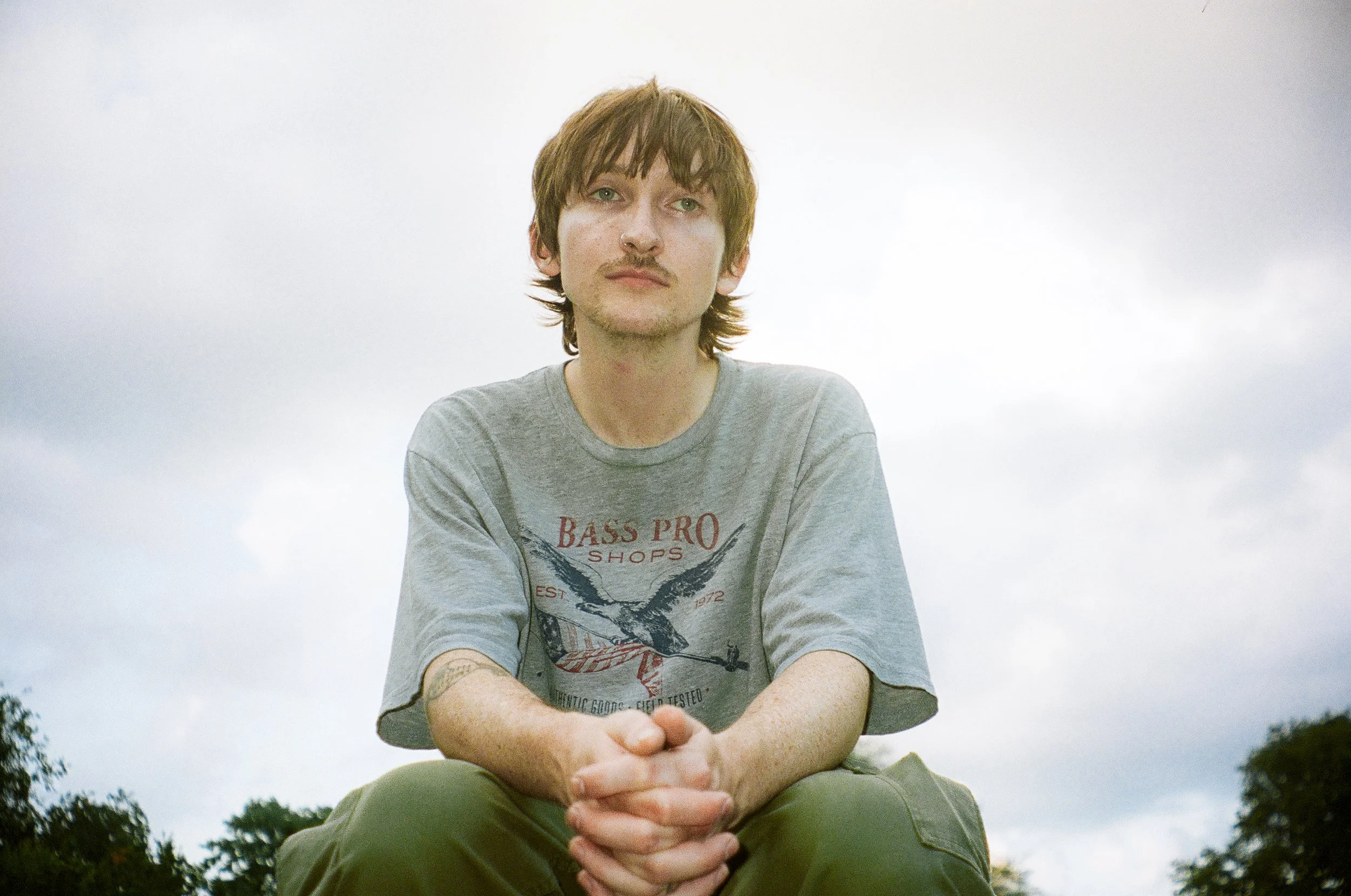
Hudson Freeman was raised evangelical and lived in Dallas, Missouri, and Africa on his way to Brooklyn, where he currently resides. His songs start with an acoustic guitar and end up somewhere stranger, run through worn-out tape machines until they sound like a broadcast drifting in over the car radio.
After a set in the Luck Chapel and a year opening for Mumford & Sons and Kings of Leon, he’s released his new album, Doom Country: a post-apocalyptic road trip back through the places he grew up, written by someone who no longer believes the theology but still feels the world ending.
We talked with Hudson about where Doom Country came from, why he wanted it to sound worn, and what he was reading and watching while he made it.

Luck: Doom Country feels like both a sound and a geographic state of mind. Where did that concept originate?
Hudson: It started from a conversation about genre with my guitarist about a year ago. We were talking about this wave we feel a part of - this twangy indie rock music - and we jokingly started calling it "Doom Country." We immediately realized it sounded like a great album title, and from there, I started extrapolating what that phrase brought to mind.
The first thing was the trope of the American road trip - records like Bruce Springsteen’s Nebraska that are foundational to Americana. But then I started thinking about another road trip trope: the post-apocalyptic journey in films and books. Growing up evangelical, ideas about the end times were constantly around me. I kept picturing those highway signs in Oklahoma and Texas declaring that the end is near. Doom Country became this idea of an apocalyptic road trip - conceptually revisiting the places I’ve lived after the end times have already happened.
Luck: Sonically, you achieve that feeling through production that feels almost haunted. How did you build that texture?
Hudson: We experimented a lot with AM radio sampling and running everything through tape machines over and over again. Tape does this thing where the pitch and speed are constantly fluctuating - that variable time is what makes old recordings feel warm, but also aged and weathered. I wanted to convey that apocalyptic feeling through degraded production choices. It’s supposed to feel like you’re picking up transmissions from the past on a car radio, hearing the breakup and static of old mediums.
Luck: That deliberate degradation stands in stark contrast to where so much of the industry is heading with hyper-clean, AI-generated polish. How do you view that friction?
Hudson: AI music is trained on pristine, high-fidelity recordings and autocorrected vocals. To me, there’s an inherent impossibility in training an algorithm on something old and having it retain authentic soul. Purposefully making music that is out of time, worn, and degraded insists on its own humanness. When you make something that is intentionally, “flawed-ly” human to begin with, you don’t have to worry about what AI is going to do to music.
Luck: You touch on lo-fi textures and degraded audio across this record, which inherently brings up this sense of the past. How do you navigate that pull toward nostalgia without getting trapped in it?
Hudson: I feel a lot of ambivalence about being super referential. Part of my desire with the experiments on this album is to push folk or indie music forward, not just look backward. But there is also this literal sense that the music feels like it's drifting in from the past. It’s a way of playing with the idea of nostalgia through the medium itself.
I’ve been reading Simon Reynolds - who wrote Retromania - and he was in dialogue with the theorist Mark Fisher. Fisher’s theory was essentially that music has redounded on so much nostalgia because of a collective inability to imagine what the future looks like. It feels too scary or too hard to imagine what society or America or music will become, so it’s comforting to steep yourself in the past.
Luck: Do you feel like relying on that past becomes a crutch, or is it just the natural human reaction to the moment we're in?
Hudson: Leaning too hard into nostalgia can become a kind of false hope. It keeps you from actually confronting the present. Part of the idea of this record is asking: What if we really just allowed ourselves to despair for a moment? Not out of cynicism, but because maybe we need to mourn. You have to have that radical honesty about where we are and not repress it if you ever want to imagine how things could actually be different.

Luck: You grew up immersed in theology around the Rapture, but you explore it on this record almost like folklore. How does that tension play out?
Hudson: That’s the productive tension of the album. I was raised to be terrified of the end of the world, and now that I don't believe in that theology, it still feels like the world is ending - just in a very different, systemic way.
I look at it like Sufjan Stevens does - using the Christian pantheon and mythology as a symbolic world to explore rather than just processing religious trauma. I don't think the literal planet is ending, but I do think American dominant civilization is coming undone. There's an intuitive realization among our leaders that dominance is slipping, which creates this frantic desire to cling to it. Exploring the fallout of an imagined Rapture is a way to look at that collective paranoia honestly.
Luck: On your single “I-40,” you capture that highway headspace vividly - especially that line, "When I wake up, I'm driving." What is happening in that space?
Hudson: It’s that alarming feeling during long-distance driving when you suddenly snap back to reality and realize you’re piloting a two-ton machine at 70 miles per hour, capable of destroying everything around you. On the road, memory and paranoia merge. You pass wind turbines that feel like they’re resenting you, and you pass billboard after billboard yelling that hell is real.
The song ends with the lines about passing through Oklahoma and the Panhandle and being "clean." It plays with salvation imagery, but it’s open-ended. It’s about that search for agency when everything feels on a collision course.

Luck: To get listeners in the right headspace on release day, give us your cultural digest. What were you reading, watching, and sitting with that helped build the world of Doom Country?
Hudson: If you want to get into the headspace of the record, start with Flannery O’Connor’s Wise Blood. It’s thick with this bizarre Southern Gothic dread, anti-evangelical street preachers, and prose where you can practically feel the Georgia humidity. On screen, The Devil All the Time hits a very similar nerve - it has that slimy, backwoods preacher energy where every step feels heavy and haunted.
Sonically, go back to Beck’s “Lost Cause” from Sea Change. It’s essentially a folk song, but the warped tape effects make it sound completely out of time. In terms of process, philosopher Todd McGowan’s work on psychoanalysis really reframed how I write - letting the voice memos roll and speaking in raw streams of consciousness.
And if you want a physical experience to ground it all? Go visit an old, non-corporate regional amusement park. To me, that’s pure Americana - these massive contraptions built purely for human joy, now sitting on the edge of memory.
Luck: You’ve talked about Charli XCX's perspective on making art - the idea that most creations eventually pass away without being remembered forever. If we are driving through a post-apocalyptic landscape, why does making art still matter?
Hudson: Because art is valuable in and of itself.
Even in the way I rearticulate my Christian upbringing, I hold on to the idea that God created the world simply for the hell of it - not out of necessity, but just for it to exist. The Genesis story, to me, is really about human creation. On the seventh day, God looks at what was made, says that’s enough, and just enjoys it for what it is.
We make things because they are gloriously complete in their own existence. Art doesn't need an imperial purpose or guaranteed immortality to matter. Making it is reason enough.
Hudson Freeman’s new standout album, Doom Country, is out now.